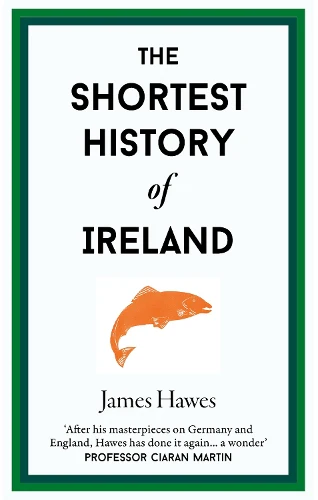
The Shortest History of Ireland
In The Shortest History of Ireland, James Hawes turns his attention to Ireland, reaching beyond the clichés to tell a dramatic new story, backed up by the latest scholarship.
The Shortest History of Ireland is based at every step on the latest scholarship, but it’s all brought together, for once, as a fluent story, as captivating as a novel, galloping from the Ice Age to the present, using language, graphics and images accessible to all. It will completely change the way people see the Irish past, flipping usual practice on its head and placing Ireland at the centre not just of Irish but British and at times even European history. Hawes concludes by arguing that if Ireland can now sidestep the last, toxic wreckage of the British Empire, its eventful past will flow into a bright future. This is popular history at its thrilling best.
Irish history is often seen as a mere catalogue of colonial repression. Yet Hawes shows that Ireland, its unique culture rooted in millennia of continuity, has always been able to assimilate would-be invaders. He reveals how the Irish, ever since the roaming saints and scholars of the early Middle Ages, helped shape Europe, then America. And he argues that, with its natural wealth, its extraordinary magnetism and its exiled children across the globe, the island only needs to sidestep the last, toxic wreckage of the British Empire for its turbulent past to flow into a bright future. With 100s of maps and images, this is popular history at its best -- a timeless drama of freedom and persecution, riot and revolution, empire and independence.
Product Information
Product Information
Shipping & Returns
Shipping & Returns
Description
In The Shortest History of Ireland, James Hawes turns his attention to Ireland, reaching beyond the clichés to tell a dramatic new story, backed up by the latest scholarship.
The Shortest History of Ireland is based at every step on the latest scholarship, but it’s all brought together, for once, as a fluent story, as captivating as a novel, galloping from the Ice Age to the present, using language, graphics and images accessible to all. It will completely change the way people see the Irish past, flipping usual practice on its head and placing Ireland at the centre not just of Irish but British and at times even European history. Hawes concludes by arguing that if Ireland can now sidestep the last, toxic wreckage of the British Empire, its eventful past will flow into a bright future. This is popular history at its thrilling best.
Irish history is often seen as a mere catalogue of colonial repression. Yet Hawes shows that Ireland, its unique culture rooted in millennia of continuity, has always been able to assimilate would-be invaders. He reveals how the Irish, ever since the roaming saints and scholars of the early Middle Ages, helped shape Europe, then America. And he argues that, with its natural wealth, its extraordinary magnetism and its exiled children across the globe, the island only needs to sidestep the last, toxic wreckage of the British Empire for its turbulent past to flow into a bright future. With 100s of maps and images, this is popular history at its best -- a timeless drama of freedom and persecution, riot and revolution, empire and independence.